At Burrow Beck, Lancaster City Council has combined a new solar farm with a programme of habitat creation. Four hectares of previously species-poor agricultural land are being planted with native wildflowers, hedgerows, trees and aquatic vegetation.
Ecologists forecast the work could increase biodiversity on the site by approximately 90%. The scale may be bigger than the average garden, business park or community space, but the principles behind it can be applied almost anywhere. And that is where smaller-scale rewilding gets interesting.
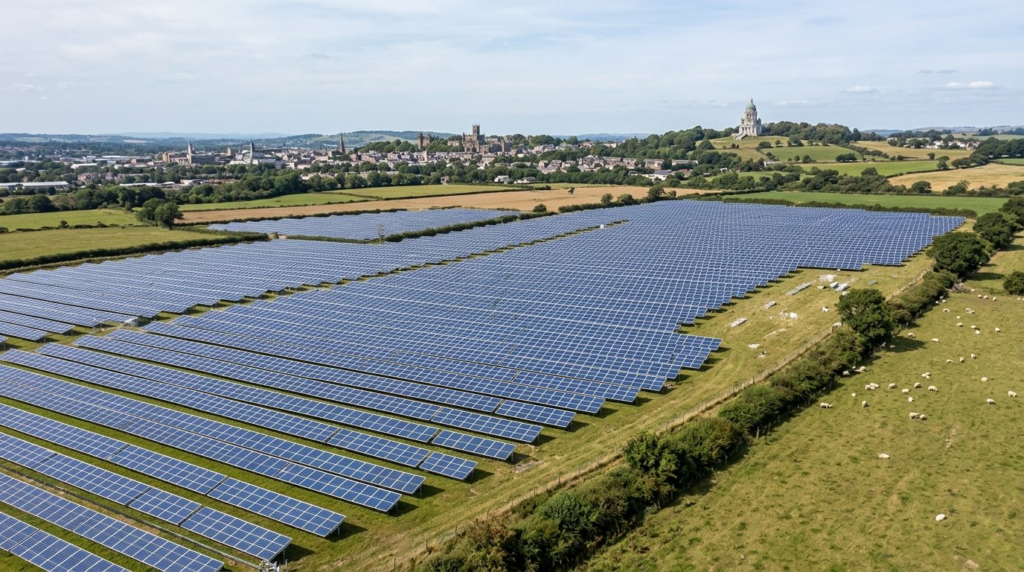
The Burrow Beck project demonstrates that we do not necessarily have to choose between land being useful for people and useful for wildlife. The same land can produce renewable electricity while also providing food, shelter and habitat for wildlife. That principle translates remarkably well to smaller spaces:
The goal isn't necessarily to abandon a space to nature.
It is to increase the amount of nature that the space can support.
One of the simplest changes is reducing the amount of frequently mown grass. Instead, allow a section to grow longer or introduce native wildflowers. Longer grass and flowering plants can provide food and shelter for insects, which in turn support birds and other wildlife. You don't have to turn the whole garden into a meadow. Start with a strip along a fence, a corner of the lawn or even a large container.
Think less mowing, more flowering.
Burrow Beck combines several different habitat types rather than relying on one intervention and you can apply the same principle at home. Try combining:
A garden containing several layers of vegetation is generally more valuable to wildlife than a garden consisting almost entirely of lawn - even a small space can contain surprising complexity.
Water can be one of the most valuable additions to a wildlife-friendly space. And you don't need a large pond. A container pond made from a half barrel, washing-up bowl or other watertight container can provide habitat for insects and drinking water for birds and other wildlife. Allow plants to grow around the edges and provide an easy escape route for anything that falls in. Small interventions can create disproportionately useful habitats.
Wildlife doesn't recognise property boundaries. That means your garden becomes more useful when it connects with other green spaces nearby.
One garden might be small but a neighbourhood full of wildlife-friendly gardens is something much bigger.
Sometimes rewilding is as much about what you stop doing as what you add:
A perfectly tidy garden often removes exactly the materials that insects, birds and other animals need. Giving nature slightly more freedom can have a surprisingly large effect.
Perhaps the most interesting aspect of Burrow Beck is where the project started. The council describes the original agricultural land as species-poor. That gives us another useful rewilding rule: don't necessarily start with the wildest part of your garden. Start with the least wild.
Look around your space:
You are looking for places where a relatively small intervention could create a large ecological improvement.
At LettsSafari, we believe rewilding should be something people can participate in rather than simply something they read about. You don't need to own a large estate nor do you need to become a conservation expert.
And you don't need to transform your entire garden overnight.
LettsSafari helps people take part in nature recovery in two complementary ways. First, our subscriptions help support our practical smaller-scale rewilding projects in the UK. Second, we help our community discover straightforward ways to make their own gardens, balconies and neighbourhood spaces more welcoming to wildlife.
The two ideas reinforce each other.
If you want to begin this week, try just one of these:
Don't worry about doing everything.
Choose one patch. Make it slightly wilder. Then see what turns up.
****************************************
Subscribe to LettsSafari
Support our rewilding parks, get exclusive content of our projects and even receive expert tips to transform your garden, community, public or work spaces into a wildlife haven.
🌱 For every 10 new subscribers we plant a tree a year.
🦔 For every 100, we release an endangered animal.
🌳 And for every 10,000 we create a new rewilding safari park a year!
Make A Difference: Together We Can Rewild To Restore Nature. Sign up TODAY!
****************************************
LettsSafari is a UK nature and rewilding initiative designed to make participation in nature recovery accessible to individuals and organisations. Subscribers help support practical rewilding while receiving ideas and inspiration for encouraging wildlife closer to home.
No. Small gardens, balconies, patios, window boxes and communal spaces can all provide useful habitat. Rewilding at this scale is about increasing the amount of food, water, shelter and connectivity available to wildlife.
You can still participate. Containers, balconies and window boxes can support pollinators, while LettsSafari also allows you to contribute to rewilding beyond your own home.
No. Small-scale rewilding can be managed and intentional. You might leave one section of lawn longer, plant native flowers or create a small pond while keeping the rest of your garden exactly as you want it.
Reducing mowing is one of the easiest. Leaving even a small section of grass longer allows plants to flower and creates additional shelter for insects.
Yes. Businesses can use LettsSafari to engage employees in practical nature recovery and help create a measurable environmental impact through the GreenTeam programme.
LettsSafari subscriptions collectively fund practical nature recovery. The model connects individual participation with larger rewilding outcomes, allowing relatively small contributions to combine into meaningful environmental action.
Yes. The greatest opportunity comes when many individual spaces begin to connect. Gardens, balconies, verges, parks and business grounds can collectively create networks of habitat through towns and cities.
The size of your space isn't the important part. What matters is how much more life you can help it support.
